


There is a passion in my heart for history that began in my junior year of college. An African American studies course opened my eyes to an important fact: In previous grades, I suffered through His Story, not history class. The realization that my history education experience had been filled with the schoolyard bully accounts of conflicts was incredibly painful. This set me on a course to learn the truth.
When I became an educator, I did not impart to my students the legacy of lies that my teachers taught me. My pupils deserved to know the truth about historical events, and I was determined to teach it to them. Teaching them about the damaging effects of white supremacy was imperative to me.
Whitewashing history reinforces the narrative that only white people make substantive contributions to the world. I view this as an ongoing and orchestrated attack on the psyche of Black and Brown people. The truth of history will not only set us free, but it will also help unite us to fight a common enemy: racism.
Songs in the Key of Freedom
There is no doubt that hymns were important in the lives of enslaved people. These stories in song transmitted messages of desire and often the path to freedom.
Follow the drinkin’ gourd
Follow the drinkin’ gourd
For the old man is comin’ just to carry you to freedom
Follow the drinkin’ gourd
— African American Hymn
“Follow the Drinking Gourd” shared instructions to anyone seeking refuge to use the Big Dipper to find the North Star and then follow the path to Canada. But while most people think of our neighbor to the north as the sole destination of the Underground Railroad, it’s important to know the rest of the story.
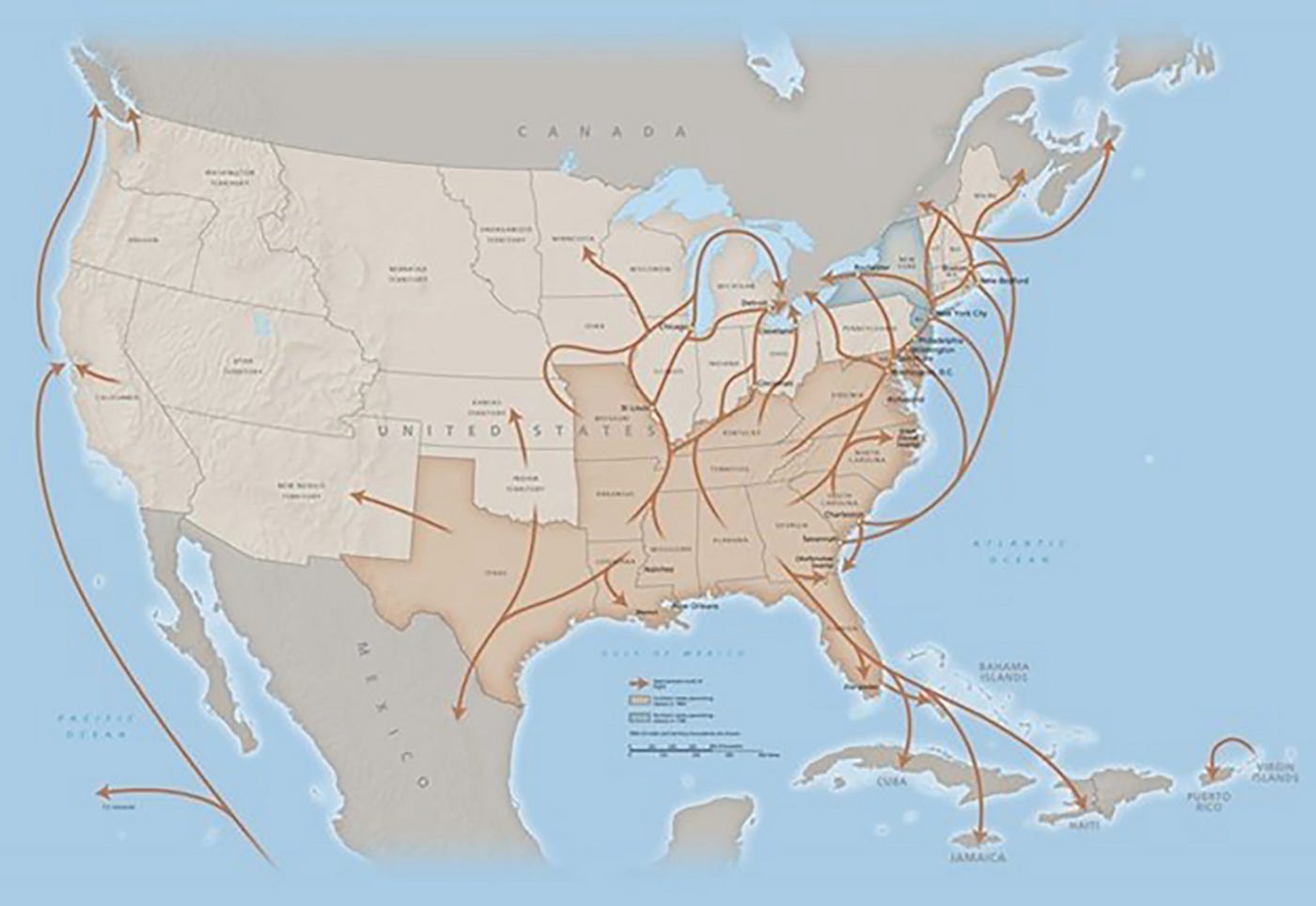
Harriet Tubman’s bravery and accomplishments cannot be understated or denied. But there were conductors of another Underground Railroad who escorted freedom-seeking people from Texas, Louisiana, Arkansas, and Mississippi who needed a more accessible geographic route of escape. The map below shows routes of the Underground Railroad leading not just north but also east, west, and south.
Vicente Guerrero, Afro-Mestizo President of Mexico
One hundred and eighty years before Barack Obama’s inauguration, Vicente Guerrero served as the second president of Mexico. While both history-makers were blessed to have African blood coursing through their veins, Guerrero’s heritage is also Mestizo—mixed Spanish and Native-Mexican, thus making him Afro-Mestizo. Guerrero was a symbol of hope and change to many people, just like Barack Obama.
Guerrero abolished slavery in Mexico on September 16, 1829. His decision was arguably the most significant event in paving the way for the Texas Revolution. The news of this decree angered Texian colonists, but brought hope to another group, the enslaved people in Coahuila y Tejas.
Even though Guerrero’s abolition of slavery in Mexico occurred over thirty years before Abraham Lincoln’s proclamation, people refer to Guerrero as Mexico’s “Abraham Lincoln.” Another common thread the two emancipators share is that both men viewed the abolition of slavery as a way to protect their respective countries.
Unchecked Anglo colonization in Coahuila y Tejas created several problems for the Mexican government. Anglo colonists were heavily invested and deeply committed to slavery. The colonists agreed to abide by Mexican laws as a condition of their residence in the Mexican state, but they reneged for financial and material gain. Outlawing slavery was a move designed to make immigration to the Mexican state unattractive. Mexico passed the Law of April 6, 1830, to stop the flood of white immigrants from the United States into their country.
The Texas Revolution in 1836 was not about freedom for the colonists. The “heroes” of the Battle of the Alamo fought not for religious freedom but to preserve and protect slavery. The famed “Father of Texas,” Stephen F. Austin, vigorously defended the practice. He warned, regarding emancipated Black people, “They will become vagabonds, a nuisance, and a menace.”
The British Are Not Coming
Abraham Lincoln used abolition as a tool to keep Britain from providing aid to the South during the Civil War. Both the North and South traded with the country before the war, but the Southerners grossly miscalculated Britain’s need for their most precious export, cotton.
Britain ended slavery at home by passing the Abolition of Slavery Act in 1833, and would have appeared grossly hypocritical if they had helped the South continue its fight to keep Black people enslaved.
So enormous, so dreadful, so irremediable did the [slave] trade’s wickedness appear that my own mind was completely made up for abolition. Let the consequences be what they would: I from this time determined that I would never rest until I had effected its abolition.
–William Wilberforce, British Politician
Lincoln was aware of this fact when he called for the abolition of slavery. His strategy helped the North maintain its advantage in terms of resources. The agrarian-based South could not manufacture all the resources needed to insure victory.
Britain proclaimed neutrality, and did not recognize the Confederacy as a nation but as rebels!
The Fugitive Slave Act of 1850
Many enslaved people in East Texas knew the path to South Texas because they routinely took cotton to shipping ports. Most were also aware of the fact that slavery was illegal in Mexico. A desert and river stood between these enslaved people and freedom. The journey to South Texas and eventually Mexico itself was worth the risk to many enslaved people.
We stand slack-jawed today when law enforcement is complicit in violatingbasic human rights, but this is nothing new. The Fugitive Slave Act of 1850 made it a duty for law enforcement officials to capture people who escaped enslavement.
There are so many tragic stories of people risking their lives to help free people from servitude. A Tejano man in South Texas partnered with a woman who had escaped slavery. When slave catchers descended upon the couple, they lynched the man and returned the woman to her former master.
The dangers of providing refuge for formerly enslaved people were tangible and horrific. Despite the potentially lethal consequences, some individuals found themselves shaken, but not stirred from their resolve. They continued to help guide their “passengers” to freedom.
The Jacksons Thrive
The Rio Grande River is the international and geographic border between the United States and Mexico. Between 1850 and 1865, an estimated 5,000–10,000 enslaved people escaped bondage by fleeing to Mexico.
Through oral history, we know about families that acted as “conductors.” They provided astonishing assistance to enslaved people seeking freedom in Mexico. Nathaniel Jackson seemed an unlikely recruit of the southern Underground Railroad. The son of a plantation owner in Alabama, Jackson married Matilda Hicks, who was previously enslaved by her husband’s father.
Jackson, his wife, and their children, along with seventeen formerly enslaved people, moved to south Texas and established the Jackson Ranch. They were deeply religious people, and Nathaniel’s faith guided him to help people seeking freedom. Jackson and his family housed and fed people who were on their way to freedom. This family did not let the fear of punishment dissuade them from assisting the freedom seekers.
The Ferry Option to Freedom
The Jacksons were farmers, and often traded goods with people in Mexico. A common way to go between the countries was by ferry. Nathaniel Jackson aided individuals seeking to start over in Mexico by way of a ferry boat ride. This was no simple feat because of the Fugitive Slave Act.
There were many forts located along the river. As previously mentioned, anyone in military or law enforcement were to uphold the Fugitive Slave Act provisions should they come across any enslaved people seeking freedom.
Since the Jacksons were farmers, it was quite natural for them to ferry their goods across the Rio Grande to Mexico. Nathaniel had a ferry landing on his property which was common among people who traded goods with Mexico. This mode of transportation provided a means for him to smuggle freedom seekers into Mexico at the risk of his own safety. All for the cause of freedom.
There Is Nothing Amicable About Slavery
Enslavers went the extra mile in their attempts to retrieve their “property.”Placing ads in newspapers for “slave catchers” was only the tip of the iceberg for the slaveholders seeking to retrieve their chattel. The slaveowners provided financial incentives for people who pursued fugitives. The deeper into Mexico the enslaved person was caught, the more money the slave catcher was paid.
The Texas Rangers were a huge posse of individuals that sought to end the freedom of individuals that had escaped bondage. The lawlessness they exhibited when hunting enslaved people and murdering Mexicans struck fear in the hearts of border residents.
Any person returning to enslavement could face punishments including whipping, jailing or death.
In true oppressive fashion, slave-owning citizens promoted a treaty with Mexico for the return of their “property” from Mexico. This treaty was similar to the Fugitive Slave Act. They proposed the “amicable” return of escaped enslaved people to the United States.
Mexico refused to acknowledge this bold request and held fast to the belief that when the “property” was on Mexican soil, it was no longer property.
A Planned Haven to Perpetuate Freedom
The Northern abolitionist Benjamin Lundy negotiated with the Mexican government to create a colony for formerly enslaved people. Colonel Juan N. Almonte planned to allow Lundy to establish this settlement in Tamaulipas. When Texas gained its independence from Mexico in 1836, dreams of the haven evaporated.
The Texas Constitution forbade free Black people to live in Texas without permission from Congress. During the nine years Texas existed as an independent nation, the industry of slavery grew and the numbers of enslaved people increased exponentially.

No Rest for the Weary
Indignant enslavers were not content with Mexico’s response to their appeal for assistance to return people who escaped from enslavement. Documented accounts exist of enslavers sending bounty hunters illegally into Mexico to retrieve their “property.” You read that right, Americans regularly trespassed on Mexican soil.
These scoundrels were often unprepared for the resistance they met. The Black Seminoles and Mascogos, helped to guard the border against slave-hunting parties. And citizens in Mexican towns frequently offered aid to individuals who successfully reached their soil and freedom.
“Fugitive” Life in Mexico
The accounts of daily life for formerly enslaved people in Mexico vary from good to mirroring enslavement.
Dan, an enslaved man who successfully escaped from Texas, married the daughter of a Mexican judge. His ability to speak Spanish and connect with the local population served him well in opening a store, and by all accounts becoming a successful merchant.
William Ellis was born into slavery, but this didn’t stop him from achieving financial success as a millionaire in Mexico. Ellis was not only the owner of several haciendas and mines in Mexico, he was a Wall Street banker as well. Stories abound of individuals living a better life in Mexico than they had in the United States.
We Have to Move Beyond Single Stories
Faulty narratives of the past not only deprive us from knowing real history, they keep us divided in the present. Black and Brown communities banded together against a common enemy: slavery. The constant single story diet I was fed growing up led me to believe things about Mexico that were not true. Whitewashing of history makes villains victors and victims villains. Our society will not heal from its inherent caste system if the role of white supremacy and its deleterious effects are not addressed.
We live in the information age and “I don’t know” is not an acceptable excuse for propagating the same lies that have been told for decades. My mom always told me that when you know better, you do better. As a nation we need to do a whole lot better and come together in meaningful ways to uplift one another.
People are not illegal. People are not aliens. People are people.
The paths some of my ancestors took to gain their freedom are being traversed today by people seeking economic relief and a better life. They may be moving in the opposite direction of my ancestors, but the goal is the same. The promise of a better life once you cross the border.
First published in Our Human Family at Medium.


Member discussion